Chalmers University Demonstrates TRIO Pulses for Control-Error-Robust Single-Qubit Gates in Superconducting Processors
Chalmers University of Technology has developed TRIO pulses, a new quantum control framework for superconducting processors. …
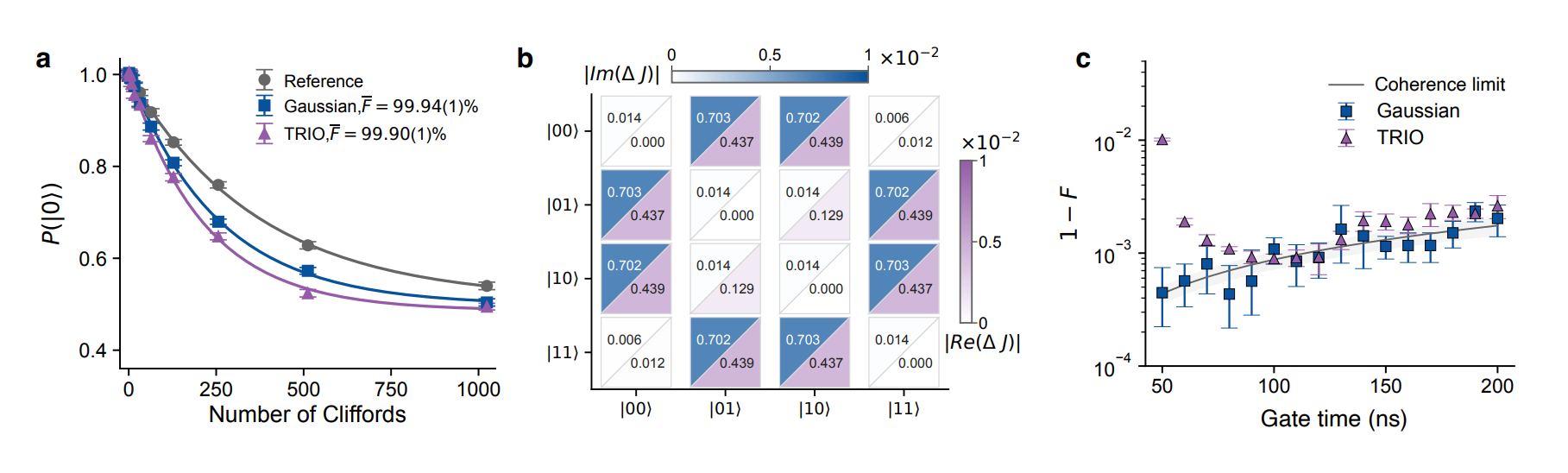
A research team led by the Wallenberg Centre for Quantum Technology (WACQT) at Chalmers University of Technology, in collaboration with Université Bourgogne Europe and Aalto University, has introduced and experimentally validated a quantum control framework termed Time-Rescaling Robust Inverse-Optimal (TRIO) pulses. Detailed in a research manuscript published on arXiv ("Optimal robust single-qubit gates in superconducting quantum processors"), the technique creates single-qubit gate envelopes that remain resilient against simultaneous control-amplitude miscalibrations and frequency detuning errors.
Tested on a superconducting transmon processor, a 90-nanosecond TRIO X-gate achieved an Interleaved Randomized Benchmarking (IRB) fidelity of 99.90%, while maintaining gate fidelities above 99.5% under simultaneous drive-amplitude variations of up to 20% and qubit detuning shifts of up to 4 MHz. Compared to standard Derivative Removal by Adiabatic Gate (DRAG) Gaussian pulses, TRIO pulses expand the parameter range for high-fidelity execution by an order of magnitude, offering a pathway to reduce periodic re-calibration overheads in large-scale quantum processors.
[ TRIO vs. Conventional Gaussian Single-Qubit Gate Benchmarks ] | |||
Control Envelope / Gate Type | Peak Gate Fidelity (90 ns) | Fidelity under 20% Amp & 4 MHz Detuning | Energy / Pulse Area Metrics |
• Gaussian X-Gate (DRAG Calibrated) | • 99.94(1)% | • ~92.0% (Narrow, sensitive tolerance window) | • Baseline pulse area (π) |
• TRIO X-Gate (Robust Inverse-Optimal) | • 99.90(1)% | • > 99.5% (Order-of-magnitude wider tolerance) | • EXopt = 3.461π (Pulse Area = 3.093π) |
• Gaussian H-Type Gate (Hadamard) | • 99.92(1)% | • Standard decay under drive distortion | • VZ(π) Y-π/2 construction |
• TRIO H-Type Universal Set (Xπ/2, Y-π/2) | • 99.60% – 99.69% | • Maintained robust plateau across parameter sweeps | • EHopt = 5.633π (Pulse Area = 3.395π) |
Time-Rescaling Inverse Optimization and DRAG Integration
Classical Robust Inverse-Optimal (RIO) pulse designs rely on inverse trajectory engineering in two-level systems, which often yields sharp, square-like waveform features that suffer distortion in finite-bandwidth microwave hardware and induce leakage into upper transmon states. The TRIO protocol overcomes this limitation by applying a time-rescaling function g(τ) to map energy-optimal Bloch-sphere trajectories onto smooth, hyper-Gaussian envelopes (ΩTR(τ)). This retains the underlying trajectory geometry while eliminating high-frequency spectral components.
The smooth TRIO pulse is further integrated with first-order DRAG corrections to mitigate higher-level transmon leakage and AC Stark shifts. The resulting complex envelope is synthesized via in-phase and quadrature (IQ) microwave phase modulation, allowing the Rabi frequency and detuning to continuously compensate accumulated errors across the trajectory.
The research team extended the TRIO framework beyond single π-rotations to create a universal single-qubit gate set (including Xπ/2 and Y-π/2 Hadamard-type operations), demonstrating average fidelities of 99.69% for Y-π/2 and 99.62% for Xπ/2. Numerical simulations indicate that applying TRIO control to physical systems with higher anharmonicity (such as 1 GHz fluxonium qubits) yields gate errors below 10-6.
Inspect the preprint on arXiv here and review the research announcement on Giovanna Tancredi's LinkedIn post here.
October 22, 2026
Related Intelligence

Test of USydney article with HTML.
EPFL Demonstrates Millimeter-Wave-to-Optical Transducer with 67% Internal Efficiency
November 10, 2026

Why Quantum Hardware Needs Its Own Threat Model
November 9, 2026
Physics Reports Analysis Evaluates Emergence of Hybrid Semiconductor–Superconducting Qubit Architectures
November 9, 2026
DLR Develops Scalable Unitary Data Encoding Beating Exponential State-Preparation Depth
November 9, 2026
IonQ and Classiq Outline Architectural Trade-Offs in Fault-Tolerant Resource Estimation
November 9, 2026