D-Wave Demonstrates 3D Analog-Digital Quantum Simulation of Higher-Order Topological Insulators Using 728 Qubits
D-Wave has successfully demonstrated 3D analog-digital quantum simulation of higher-order topological insulators using up to 728 qubits on an Advantage2…
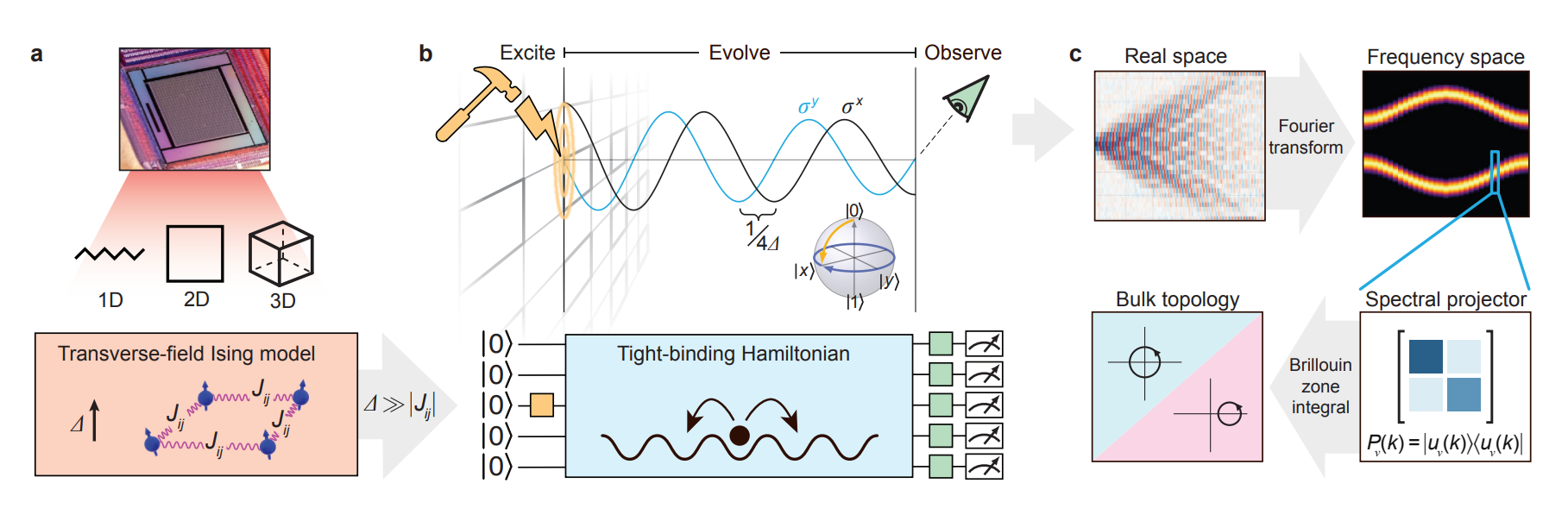
In a research study published on arXiv, scientists at D-Wave Quantum (Pratik Sathe, Andrew D. King, and collaborators) have demonstrated the realization and characterization of 1D, 2D, and 3D higher-order topological insulators (HOTIs) on an Advantage2 superconducting quantum annealing processor using up to 728 qubits.
Detailed in the paper ("Measuring higher-order bulk topology in a programmable quantum simulator"), the team deployed new analog-digital quantum control protocols to measure localized boundary modes and extract 3D bulk topological invariants via band projector tomography.
[ Experimental Performance & Topological Benchmark Comparison ] | |||
Topological Model / Dimension | Qubit Count / Setup | Boundary Measurement (LDOS) | Bulk Topological Invariant |
• 1D SSH Model | • 64 Qubits (L = 32 Chain) | • In-Gap Fractional End Modes | • Zak Phase (γ = π) |
• 2D BBH Quadrupole Insulator | • 364 Dimers (L = 13 Skew) | • Localized Zero-D Corner Modes | • 2D Quadrupole Moment (pxy = 1/2) |
• 3D BBH Octupole Insulator | • 432 Qubits (3x3x3 Lattice) | • Gapped Bulk/Face/Hinge + Corners | • 3D Octupole Moment (1/2) |
Analog-Digital Control Protocols & Dimerized 3D Lattices
Traditional quantum annealing applications rely on slow global quenches or static ground-state sampling. D-Wave's new analog-digital architecture combines pulse-level state initialization, coherent static Hamiltonian evolution, and high-frequency time-series measurements:
Qubit Dimerization: To embed dense 2D and 3D connectivity onto the processor graph, physical qubits were paired into strongly coupled dimers (Jd = 2.5 GHz, Δ = 3.0 GHz), acting as effective two-level systems to realize Benalcazar-Bernevig-Hughes (BBH) tight-binding models.
Complex Wavefunction Tomography: By time-shifting σrx(t) measurements by 1/(4Δ) = 125 ps, the system reconstructed the complex-valued propagator Ψr(t) = σrx(t) + iσry(t) with a temporal resolution of δt = 62.5 ps.
First Experimental Extraction of 3D Bulk Topology: By calculating three successive nested Wilson loops from experimentally reconstructed occupied-band projectors {Pν(k)}, the team measured the quantized 3D electric octupole moment (1/2 invariant), verifying the bulk-boundary correspondence in a 3D quantum simulator.
Fractionalized Charge Deficits: Ingesting real-space return amplitudes into local density of states (LDOS) integrals revealed fractionalized charge deficits (≈ 1/2) localized at zero-dimensional corner modes.
Insensitivity to Local Disorder: Bootstrapping over physical lattice symmetries proved that the bulk topological invariants remain quantized near 1/2 even without enforcing ideal spatial symmetries, demonstrating topological protection against mild hardware disorder.
The demonstration confirms that analog-digital quantum annealing hardware can serve as a programmable simulator for multi-dimensional condensed matter physics and non-interacting topological materials.
Review Andrew King's summary on LinkedIn here and inspect the technical manuscript on arXiv here.
October 17, 2026
Related Intelligence

Test of USydney article with HTML.
EPFL Demonstrates Millimeter-Wave-to-Optical Transducer with 67% Internal Efficiency
November 10, 2026
Why Quantum Hardware Needs Its Own Threat Model
November 9, 2026
Physics Reports Analysis Evaluates Emergence of Hybrid Semiconductor–Superconducting Qubit Architectures
November 9, 2026
DLR Develops Scalable Unitary Data Encoding Beating Exponential State-Preparation Depth
November 9, 2026
IonQ and Classiq Outline Architectural Trade-Offs in Fault-Tolerant Resource Estimation
November 9, 2026