IBM is Using AI to Help Identify New Quantum Error Correction Codes
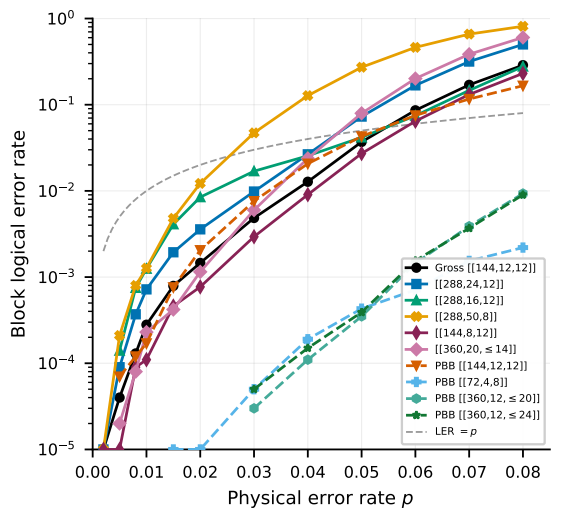
Searching for optimal Quantum Error Correction (QEC) codes is an incredibly time-consuming and computationally demanding bottleneck due to the vast space of potential algebraic formulations. To address this, IBM researchers have introduced OpenEvolve, an open-source, LLM-guided evolutionary AI framework that dramatically accelerates the discovery of viable QEC codes. The framework establishes a powerful, two-way interplay between classical AI and quantum computing. It utilizes large language models (LLMs) to generate informed hypotheses for algebraic expressions that could serve as valid code candidates.
Key Performance Results
The research team tested their framework by targeting bivariate bicycle (BB) codes—a class of quantum low-density parity check (qLDPC) codes featured on IBM’s fault-tolerant quantum computing roadmap.
QEC codes are formally evaluated using the format [[n, k, d]], where n represents physical qubits, k represents logical qubits, and d is the "distance" (error tolerance). In practice, maximizing these three parameters involves stark trade-offs. The evolutionary campaign successfully discovered 465 new error correction codes, showcasing diverse structural trade-offs. The table below shows a few examples of codes it found that provide different trade-offs, each of which might be advantageous for different situations.
Discovered Code Structure | Highlighted Properties & Trade-offs |
High Logical Qubit Count [[288,50,8]] | Discovered a candidate featuring an eye-catching 50 logical qubits (k=50), drastically shattering the previous record of 16 within this code family (though bounded by a low distance d). |
Hardware-Optimized [[72,4,8]] | Found a compact code requiring only 72 physical qubits (n=72), which may prove significantly easier to implement on near-term quantum hardware platforms. |
Balanced Candidates [[288,16,12]] and [[360,12,≤24]]) | Generated balanced profiles with predicted noise-handling capabilities that competitively compare to IBM's highly studied [[144, 12, 12]] "gross code". |
Moving Forward
While further research is required to evaluate how these AI-generated codes perform in real-world physical architectures, OpenEvolve establishes a highly viable methodology for exploring massive algebraic code spaces. IBM Research has fully open-sourced the OpenEvolve library on GitHub, encouraging the global quantum research community to leverage and extend the framework for broader quantum error correction discovery.
Additional information on this research can be found in an IBM Research blog located here and also a preprint posted on arXiv here.
June 13, 2026
Related Intelligence

Test of USydney article with HTML.
MIT and IBM Project Quantum Unity Operators into Language Model Latent Spaces for Multimodal Circuit Synthesis
July 11, 2026

ETH Zurich Combines Superconducting Qubits with Mechanical Resonators to Build Vibrating Quantum RAM
July 11, 2026

Google and Fraunhofer Launch Global Calls for Early Fault-Tolerant Algorithms and Enterprise Use Cases
July 11, 2026

Who’s News: Strategic Appointments at Photonic, Aliro Quantum, Florida Atlantic University, QuSecure, Quantum Elements, and QAI Ventures
July 11, 2026

EeroQ Validates CMOS-Controlled Electron Shuttling on Superfluid Helium for All-to-All Qubit Routing
July 11, 2026