Los Alamos and QC Ware Model Correlated Iron Oxides Using Sample-Based Quantum Diagonalization on IBM Hardware
Researchers from Los Alamos National Laboratory and QC Ware developed a hybrid quantum-classical workflow to simulate strongly correlated transition…
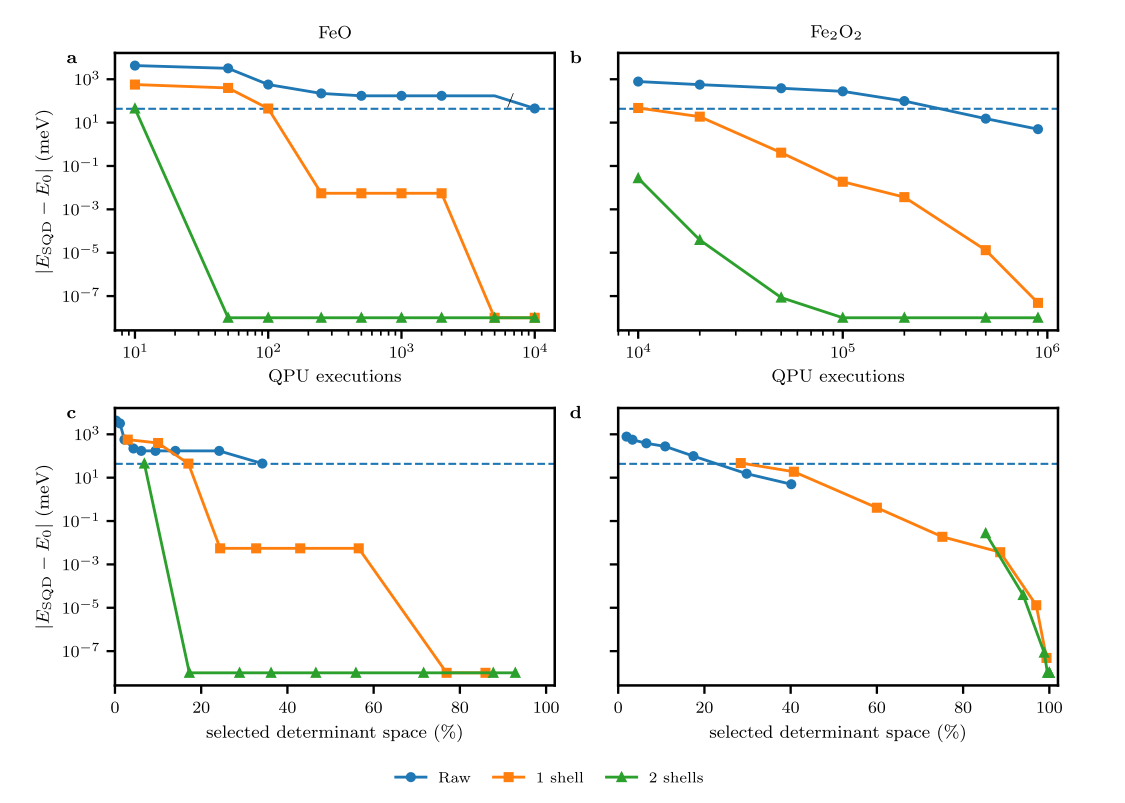
In a preprint titled Towards Quantum Computation of Bulk FeO, researchers from Los Alamos National Laboratory (LANL) and QC Ware present a hybrid workflow simulating strongly correlated transition metal oxides on quantum processors. Benchmarked on diatomic iron monoxide (FeO) and rhombic iron oxide dimers (Fe2O2), the team coupled ab initio-informed d-p tight-binding models with Sample-based Quantum Diagonalization (SQD) on IBM Quantum's ibm_miami system, using near-term hardware purely as a Fock-space sampler to reach chemical accuracy where standalone Variational Quantum Eigensolver (VQE) optimizations stall.
LANL / QC Ware Correlated Electronic Structure Benchmarks | ||
System Dimension | FeO Diatomic Molecule | Fe2O2 Rhombic Dimer |
Active Space & Qubit Footprint | 12 electrons in 16 spin orbitals (16 qubits) | 24 electrons in 32 spin orbitals (32 qubits) |
Hardware Multiplexing ( | 6 parallel instances across 96 qubits | 3 parallel instances across 96 qubits |
Ansatz Architecture | 1-layer LUCJ (120 variational parameters) | 1-layer LUCJ (496 variational parameters) |
Raw VQE Performance | Residual error ΔE ≈ 173 meV (exceeds 43 meV limit) | Trapped in nonlinear variational parameter manifold |
SQD Post-Processing | Ground doublet recovered in 184 determinants (< 43 meV) | Chemical accuracy achieved via 1-shell expansion |
Physical State Recovered | Experimental quintet (5Δi); ΔEexc ≈ 2,167 cm−1 | Nonet magnetic ground state (MS = 4 sector) |
Bulk FeO is an archetypal Mott insulator whose strong electronic correlations cause conventional density functional theory (DFT) to mischaracterize it as metallic. To make these open-shell systems computationally tractable, the authors extracted localized Wannier functions from non-spin-polarized DFT calculations to build multi-orbital d-p Hamiltonians. Variational states were parameterized using a one-layer Local Unitary Cluster Jastrow (LUCJ) ansatz, which restricts two-mode Givens rotations to nearest-neighbor connectivity to eliminate non-local SWAP overheads.
To bypass on-hardware barren plateaus, circuit parameters were optimized in classical statevector simulations and deployed to frozen QPUs strictly for configuration sampling. Measured bitstrings post-selected for particle-number conservation were then expanded into one- and two-shell Fock-space graphs based on non-zero Hamiltonian matrix elements. Classical exact diagonalization of the resulting projected Hamiltonian converged rapidly: two connectivity shells recovered the experimental 5Δi quintet state for FeO within a compressed subspace of 184 determinants, yielding an excitation energy of 2,167 cm−1 (substantially outperforming prior multireference configuration interaction baselines that predicted 300 cm−1). The methodology establishes a blueprint for modeling bulk periodic FeO by distributing SQD sub-blocks across Brillouin zone k-points.
The preprint is accessible on arXiv here.
October 31, 2026
Related Intelligence

Test of USydney article with HTML.
EPFL Demonstrates Millimeter-Wave-to-Optical Transducer with 67% Internal Efficiency
November 10, 2026

Why Quantum Hardware Needs Its Own Threat Model
November 9, 2026
Physics Reports Analysis Evaluates Emergence of Hybrid Semiconductor–Superconducting Qubit Architectures
November 9, 2026
DLR Develops Scalable Unitary Data Encoding Beating Exponential State-Preparation Depth
November 9, 2026
IonQ and Classiq Outline Architectural Trade-Offs in Fault-Tolerant Resource Estimation
November 9, 2026