NVIDIA Unveils CUDA-Q Logical to Accelerate Fault-Tolerant System Orchestration Across Hardware Modalities
NVIDIA has launched CUDA-Q Logical, an extension to its open-source accelerated quantum computing platform, aimed at accelerating fault-tolerant quantum…

At IEEE Quantum Week 2026 in Toronto, NVIDIA announced a major extension to its open-source accelerated quantum computing platform with the release of CUDA-Q Logical. Sitting directly above the physical execution layer, CUDA-Q Logical introduces an extensible, retargetable compilation and orchestration framework designed to address the central bottleneck of fault-tolerant quantum computing (FTQC): co-designing high-level logical algorithms, quantum error correction (QEC) codes, real-time decoders, and physical QPU micro-architectures within a single unified pipeline.
Detailed in a research publication by NVIDIA's quantum engineering team, CUDA-Q Logical lowers target-independent quantum programs through a virtual logical machine architecture, generating QEC microcode, physical pulse schedules, and real-time control plans while preserving semantic provenance. The platform enables direct derivation of full-stack resource estimates from actual compiler artifacts rather than abstract analytical formulas. Early deployment across national laboratories and hardware developers demonstrated dramatic design accelerations: Fermi National Accelerator Laboratory (Fermilab) reported accelerating fault-tolerant system resource modeling from five months down to three weeks—a 7× operational speedup. Simultaneously, the U.S. Department of Energy’s Sandia National Laboratories integrated its newly introduced Quantum Universal Operations Performance System (QUOPS) cross-platform utility benchmark natively within CUDA-Q.
[ NVIDIA CUDA-Q & NVQLink Q3 2026 Ecosystem Integration Matrix ] | ||
Integrator / Partner | Hardware Modality & Software Layer | Key Performance Output & Technical Benchmark |
Iceberg Quantum & Diraq | • Silicon CMOS Spin-Qubit QPU • Iceberg Pinnacle qLDPC Code Mapping | • 1,000 Logical Qubits from 150,000 Physical Qubits • ~10× Reduction in Physical Qubit Overhead |
Infleqtion | • Reconfigurable Neutral-Atom Array • Hypergraph-Product Simplex [[98,18,4]] qLDPC | • 18 Logical Qubits in 98 Data Qubits (~5.4 Physical/Logical) • 18.4% Code Rate | 5× Savings vs. Distance-3 Surface Code |
IQM Quantum Computers | • 150-Qubit Halocene Superconducting QPU • NVIDIA NVQLink Low-Latency Interconnect | • Open-Architecture Logical Compilation & Resource Auditing • Sub-Microsecond Real-Time GPU Decoder Coupling |
Quantum Motion | • Silicon Spin CMOS Transistor Architecture • 3D Stacked Virtual-z Surface Code Topology | • Automated QIR Output for Shuttling-Based Physical Loops • Target FTQC Resource Estimates for FeMoco Chemistry |
QC Design | • Plaquette FTQC Simulation Engine • Hardware-Realistic Non-Pauli Noise Injection | • 0.2% Two-Qubit Gate Leakage Modeled in Lattice Surgery • Identified 60% Reduction in Logical Noise Threshold |
Anyon Computing | • Superconducting QPU Data Center Nodes • Open-Source Control Plane via NVQLink | • Unified RDMA-over-Ethernet Memory Space (CPU/GPU/QPU) • Microsecond Control Loops Engineered by AI Agents |
Quandela | • Photonic MosaiQ & SPOQC QPUs • Quantum System Controller (QSC) + NVQLink | • Sub-4-Microsecond GPU-QSC Interconnect Latency • MerLin Photonic QML Framework & GPU Digital Twins |
Sandia & Quantinuum | • Cross-Platform System Benchmarking • QUOPS Metrics Baseline (arXiv:2609.12146) | • Quantinuum Helios-1 (Physical Q=1,504 | 8-Logical Q=40) • Quantified 5-Order-of-Magnitude Gap to Utility Targets |
BlueQubit | • $150,000 Compute Grant Program • Unified Cloud Pipeline (AWS, IBM, NVIDIA) | • AI-Driven QEC Code Discovery & Tensor Simulation • QPU Hardware Validation vs. Classical Benchmarks |
QCentroid & CESGA | • QuantumOps Platform & QATALIZE Project • PyTorch + CUDA-Q Hybrid Generative AI Stack | • Boundary Engineering in Qmio 32-Qubit Superconducting QPU • DFT-Validated Hit Rate Metrics for Catalyst Discovery |
IonQ & Ecosystem | • Trapped-Ion QPUs (Forte, Tempo Series) • IEEE QCE26 Award-Winning Research Portfolio | • 14.6% Acceleration in Synopsys FEA (35M Elements) • 24% AI Error Reduction | Energy-to-Solution Break-Even at ~34 Qubits |
UCLA, Caltech, & NVIDIA | • Differentiable Fourier Neural Operator (FNO) • CUDA-Q Dynamics Simulation Surrogate | • ~10⁷× Speedup vs. GPU Numerical Propagation Solvers • FNO-SPMP Achieved 86.2% State Preparation Success on H₃O⁺ |
MITRE, SandboxAQ, & QB | • Tangent Master Equation (TME) Open System
• cuQuantum | • Decoupled NV-Center Error Limits (Dephasing/Thermal/Leakage) • OPM Array Medical Target: 5 mm Localization Error |
The CUDA-Q Logical release coincides with rapid adoption of NVIDIA's NVQLink low-latency interconnect protocol and GPU-accelerated quantum simulation libraries (cuQuantum, cuTensorNet, and Ising models) across the international ecosystem. By standardizing retargetable compilation layers, hardware developers can plug proprietary QPU architectures into open resource estimation toolchains without exposing trade secrets, establishing an auditable foundation for utility-scale quantum-GPU supercomputers.
Review the official announcement via NVIDIA Newsroom here, access the technical paper on NVIDIA Research here, and explore our full series of detailed architectural analyses on Quantum Computing Report by GQI:
Infleqtion Integrates Open-Source qLDPC Library with NVIDIA CUDA-Q Logical
IQM Adopts NVIDIA CUDA-Q Logical Framework for Open FTQC Benchmarking
QC Design Integrates Plaquette Platform with NVIDIA CUDA-Q Logical
Quantum Motion Integrates Silicon Spin Architecture with NVIDIA CUDA-Q Logical
Iceberg Quantum & Diraq Validate Pinnacle qLDPC Architecture via CUDA-Q Logical
Sandia, Quantinuum, and NVIDIA Introduce QUOPS Benchmarking Framework
Anyon Computing Unveils Open-Source Control Plane Powered by NVIDIA NVQLink
Quandela and NVIDIA Outline Photonic QPU Integration Architecture via NVQLink
BlueQubit Launches $150,000 "Quantum Flywheel" Grant Program Supported by NVIDIA
Qedma Integrates QESEM Quantum Error Mitigation Software into NVIDIA CUDA-Q
IonQ Demonstrates Hybrid HPC and Quantum-AI Workflows at IEEE Quantum Week 2026
MITRE, Quantum Brilliance, NVIDIA, & SandboxAQ Introduce Sensor Digital Twins
Phasecraft & NVIDIA Benchmark 3,000 VQE Molecular Emulations under Q4Bio
UCLA, Caltech, and NVIDIA Develop Fourier Neural Operator for Quantum Control
September 14, 2026
Related Intelligence

Test of USydney article with HTML.
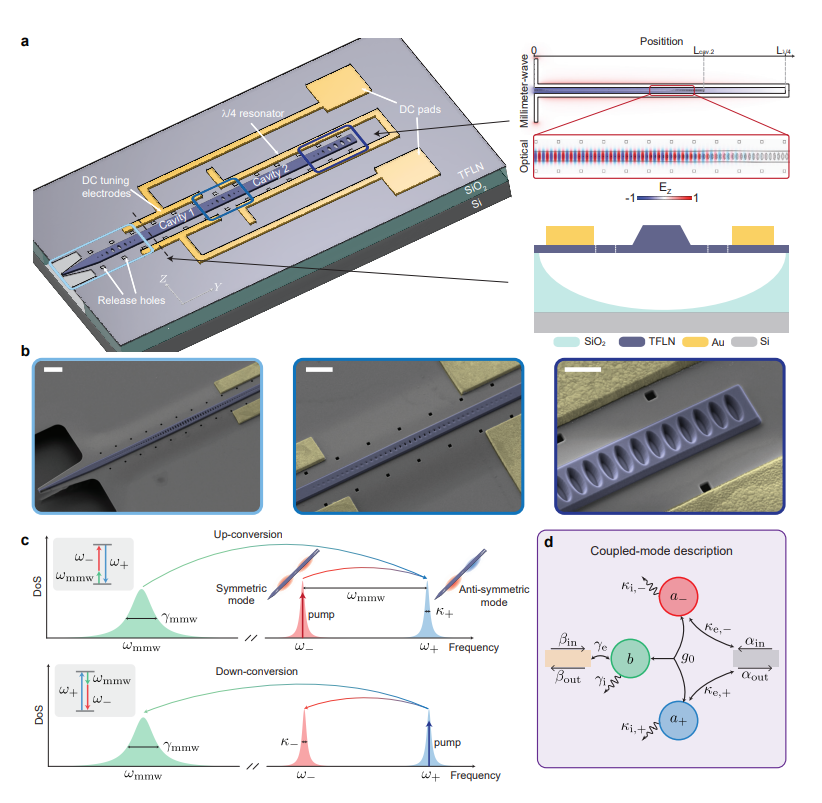
EPFL Demonstrates Millimeter-Wave-to-Optical Transducer with 67% Internal Efficiency
November 10, 2026
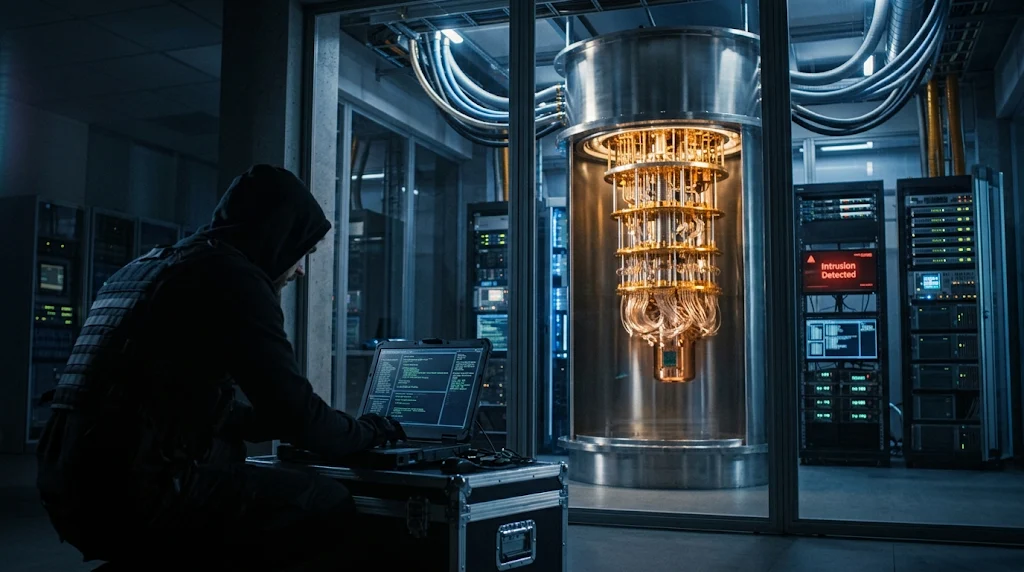
Why Quantum Hardware Needs Its Own Threat Model
November 9, 2026
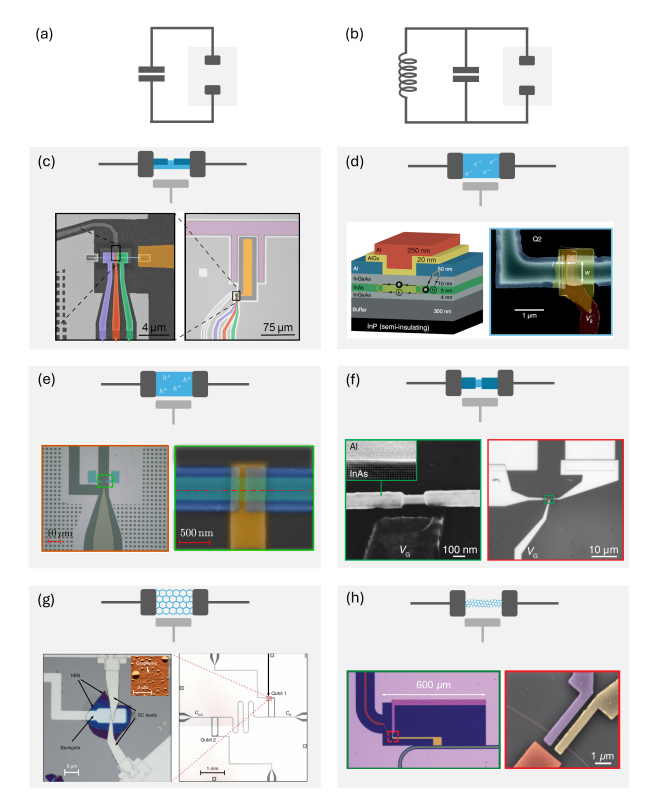
Physics Reports Analysis Evaluates Emergence of Hybrid Semiconductor–Superconducting Qubit Architectures
November 9, 2026
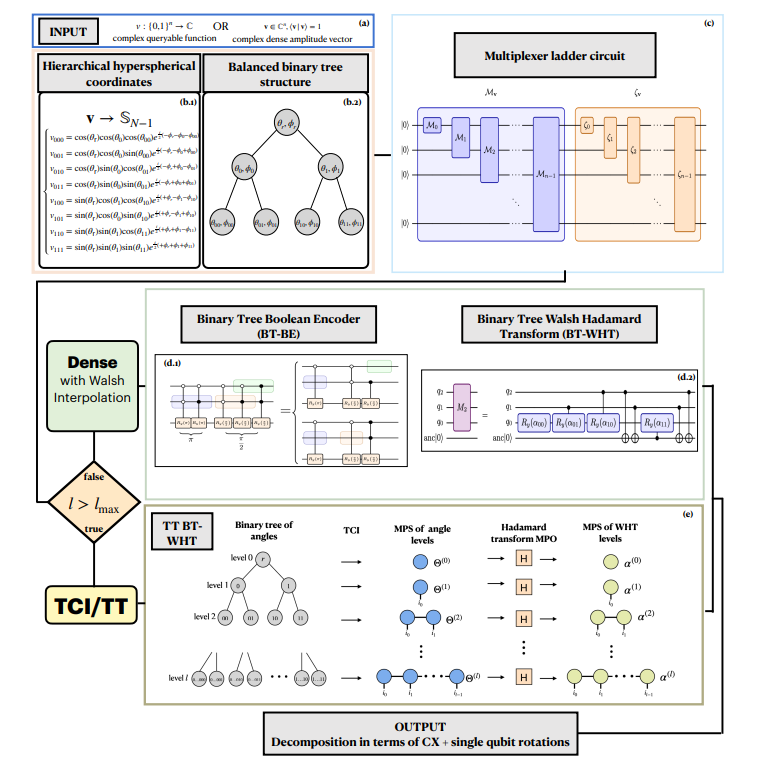
DLR Develops Scalable Unitary Data Encoding Beating Exponential State-Preparation Depth
November 9, 2026
IonQ and Classiq Outline Architectural Trade-Offs in Fault-Tolerant Resource Estimation
November 9, 2026