NVision Demonstrates Addressable Molecular Spin-Photon Interface and Partners with HyperLight for Integrated Photonic Hardware
NVision Quantum Technologies has demonstrated a new quantum computing platform using organic carbene molecules as qubits, achieving single-molecule…
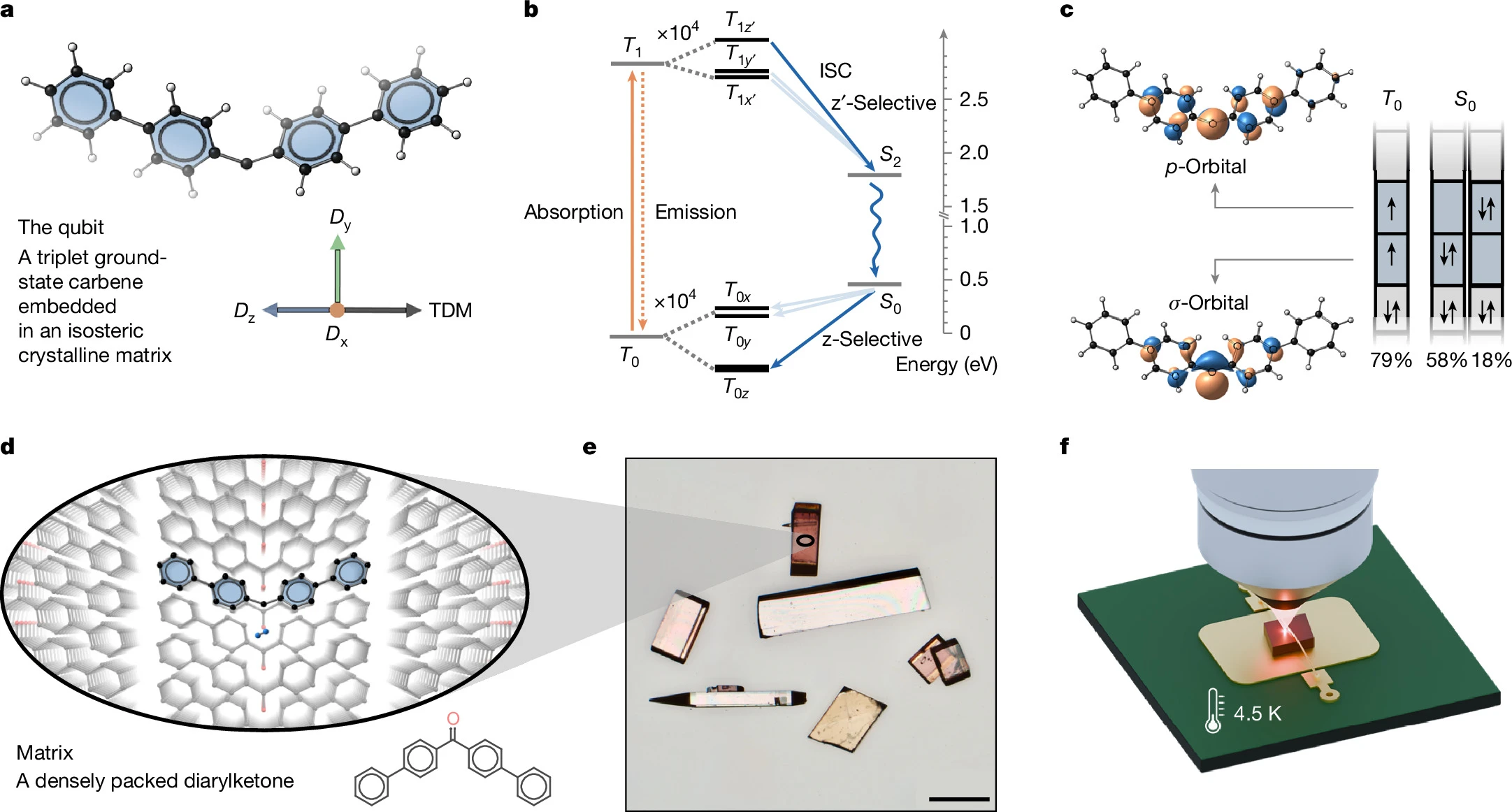
NVision Quantum Technologies has demonstrated an individually addressable organic molecular spin-photon interface and established a hardware development partnership with HyperLight Corporation to deposit molecular qubit thin films directly onto photonic integrated circuits (PICs). In peer-reviewed research published in Nature, researchers from NVision Imaging Technologies GmbH, Ulm University, and The Hebrew University of Jerusalem achieved single-molecule coherent control, optical initialization, and readout using synthetic carbene molecules. The platform provides an alternative to cleanroom-fabricated semiconductor color centers by utilizing solution-processed molecules deposited onto thin-film lithium niobate (TFLN) optical substrates, aiming for compatibility with standard semiconductor manufacturing lines.
Molecular Spin Architecture and Measured Coherence Metrics
The system utilizes an engineered organic carbene molecule—a divalent carbon unit bearing aromatic biphenyl groups—embedded substitutionally inside an isosteric organic host crystal. A focused laser initiates a reaction that photo-eliminates nitrogen from a diazomethane precursor compound, creating individual stationary qubits within the crystal with sub-micrometer spatial precision. Operating at 4.5 K, the electron spin is protected from magnetic noise caused by surrounding hydrogen atoms thanks to large internal zero-field splitting parameters (|D| = 11.16 GHz and |E| = 0.54 GHz). Shining laser light at a wavelength of 595.04 nm allows researchers to read and initialize single electron spins via a zero-phonon line (ZPL). Single-photon detector measurements confirmed individual molecular operation, yielding a single-photon antibunching dip of g(2)(0) = 0.142, while pulsed microwave control extended quantum coherence to 2.2 ms using dynamical decoupling sequences.
Measured Physical and Coherence Benchmarks (Single Carbene Qubit at 4.5 K) | ||
Operational Metric | Measured Value | Functional Role in Architecture |
Operating Temperature | 4.5 K | Functions in helium cryostats without requiring dilution refrigeration. |
Zero-Phonon Line (ZPL) Emission | 595.04 nm | Provides the optical wavelength used to address and read out the qubit. |
Single-Emitter Optical Linewidth | 38(2) MHz | Ensures sharp, spectrally distinguishable optical transitions for single spins. |
Single-Photon Purity (g(2)(0)) | 0.142 | Confirms light emission originates from an isolated single molecule (threshold < 0.5). |
Decoupled Spin Coherence (T2(XY8)) | 2.2(3) ms | Preserves quantum state memory against background environmental noise. |
Spin-Lattice Relaxation (T1) | 21(2) ms | Sets the physical upper bound for spin lifetime in the crystal matrix. |
TFLN Chiplet Integration and Scalability Constraints
Under the commercial partnership, NVision plans to deposit carbene thin films directly onto HyperLight's TFLN Chiplet photonic platform. This design routes emitted photons through on-chip waveguides to link separate qubits optically, bypassing the physical wiring bottlenecks and cross-talk common in tightly packed solid-state chips. In NVision's broader Photonic Integrated Quantum Circuits (PIQC) framework, the molecular electron spin acts as the optical communication interface, while integrated nuclear spins (such as site-selective carbon-13 isotopes) are intended to function as long-lived register memories. While the molecular spin transitions are separated by at least 1.555 GHz and the architecture is designed to tolerate up to 70% optical loss, significant technical challenges remain. Industrial deployment will depend on achieving uniform molecular film deposition across large wafers, minimizing optical coupling losses between molecules and waveguides, and demonstrating high-fidelity entangling gates between distinct qubits. NVision is targeting a prototype on-chip demonstration by the end of 2026, with an operational roadmap aiming for fault-tolerant logical systems by 2030.
The experimental study is published in Nature here, architectural context is detailed in NVision's Technical Breakdown here, and commercial partnership details are disclosed in the NVision Announcement here.
October 28, 2026
Related Intelligence

Test of USydney article with HTML.
EPFL Demonstrates Millimeter-Wave-to-Optical Transducer with 67% Internal Efficiency
November 10, 2026

Why Quantum Hardware Needs Its Own Threat Model
November 9, 2026
Physics Reports Analysis Evaluates Emergence of Hybrid Semiconductor–Superconducting Qubit Architectures
November 9, 2026
DLR Develops Scalable Unitary Data Encoding Beating Exponential State-Preparation Depth
November 9, 2026
IonQ and Classiq Outline Architectural Trade-Offs in Fault-Tolerant Resource Estimation
November 9, 2026