Quantum Motion Integrates Silicon Spin Architecture with NVIDIA CUDA-Q Logical Compiler Stack
Quantum Motion has integrated its silicon spin architecture with NVIDIA CUDA-Q Logical, enabling automated quantum error correction-aware compilation. …
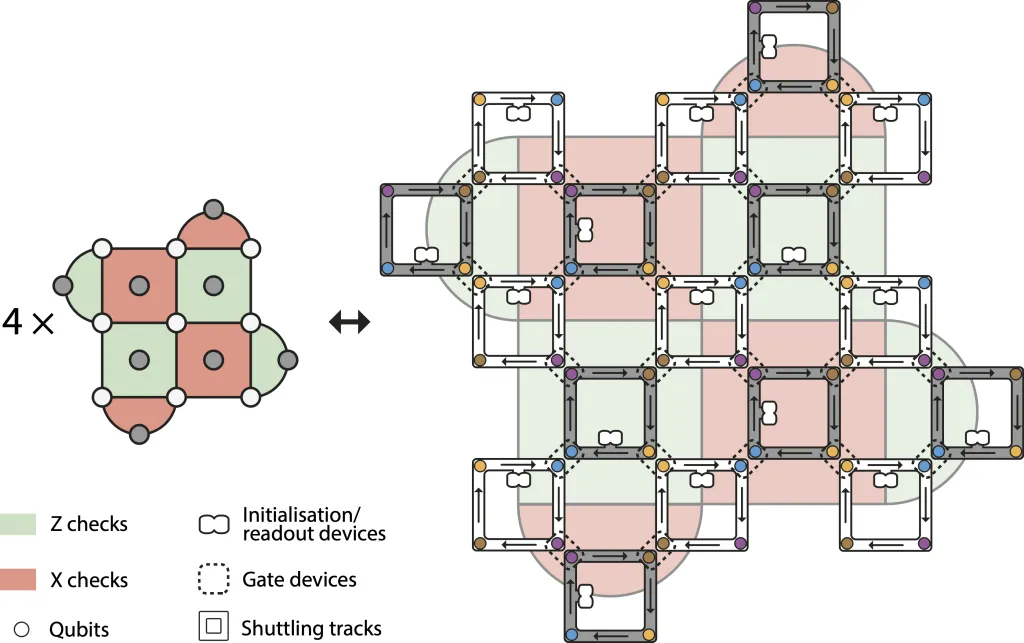
Silicon spin-qubit developer Quantum Motion has integrated its software pipeline with NVIDIA CUDA-Q Logical, an open-source logical orchestration and compilation layer within the CUDA-Q platform. The integration automates quantum error correction (QEC)-aware compilation, translating high-level logical algorithm primitives into hardware-level instructions mapped directly to Quantum Motion's silicon spin QPU topologies.
The compilation architecture specifically models Quantum Motion's looped pipeline architecture, which relies on electron shuttling—the physical translation of individual electron spins across the silicon substrate—to link processing nodes without dense physical wiring interconnects. By shuttling multiple qubits within localized physical loops, the hardware enables fast transversal two-qubit operations between surface code layers, turning standard two-dimensional (2D) planar surface code layouts into a three-dimensional (3D) virtual-z topology. The CUDA-Q Logical integration automates spatial placement by routing frequently interacting logical qubits into shared physical loops, replacing manual compilation estimates with Quantum Intermediate Representation (QIR) instruction output.
[ Quantum Motion & NVIDIA CUDA-Q Logical Integration Architecture ] | ||
Architectural Component | Hardware & QEC Implementation | CUDA-Q Logical Software Function |
Physical & Interconnect Layer | • 300mm CMOS Silicon Spin Transistors • Electron Shuttling Inter-Qubit Links | • Micro-Topology Hardware Mapping • Executable QIR Instruction Generation |
QEC Geometry | • 3D Stacked Surface Code Layout • Fast Virtual-z Transversal Gates | • QEC-Aware Subroutine Placement • Automated Primitive-to-Pulse Breakdown |
Target Workloads | • Complex Electronic Structure (FeMoco) • QUICHE ORCA Software Pipeline Integration | • End-to-End Fault-Tolerant Compilation • Multi-Logical Qubit Resource Estimation |
The automated compilation stack targets large-scale electronic structure calculations, providing end-to-end logical resource estimation for complex molecular systems like the iron-molybdenum cofactor (FeMoco). The workflow interfaces with Quantum Motion's ongoing algorithms research—including the QUICHE (QUantum Integrated CHEmistry) project alongside FACCTs and Riverlane—to establish automated pipelines from high-level computational chemistry software (ORCA) down to hardware-executable fault-tolerant logical circuits.
Review the technical update via Quantum Motion here, examine our previous analysis of The QUICHE Project's Quantum Chemistry Workflow Integration here, and read our prior coverage of Quantum Motion and NVIDIA Partnering to Resolve State Preparation Obstacles in Quantum Chemistry here.
September 14, 2026
Related Intelligence

Test of USydney article with HTML.
EPFL Demonstrates Millimeter-Wave-to-Optical Transducer with 67% Internal Efficiency
November 10, 2026

Why Quantum Hardware Needs Its Own Threat Model
November 9, 2026
Physics Reports Analysis Evaluates Emergence of Hybrid Semiconductor–Superconducting Qubit Architectures
November 9, 2026
DLR Develops Scalable Unitary Data Encoding Beating Exponential State-Preparation Depth
November 9, 2026
IonQ and Classiq Outline Architectural Trade-Offs in Fault-Tolerant Resource Estimation
November 9, 2026