UCLA, Caltech, and NVIDIA Develop Fourier Neural Operator for Quantum Control Sequence Synthesis
A research collaboration involving UCLA, Caltech, and NVIDIA has developed a machine-learning framework utilizing a Fourier Neural Operator (FNO) for the…
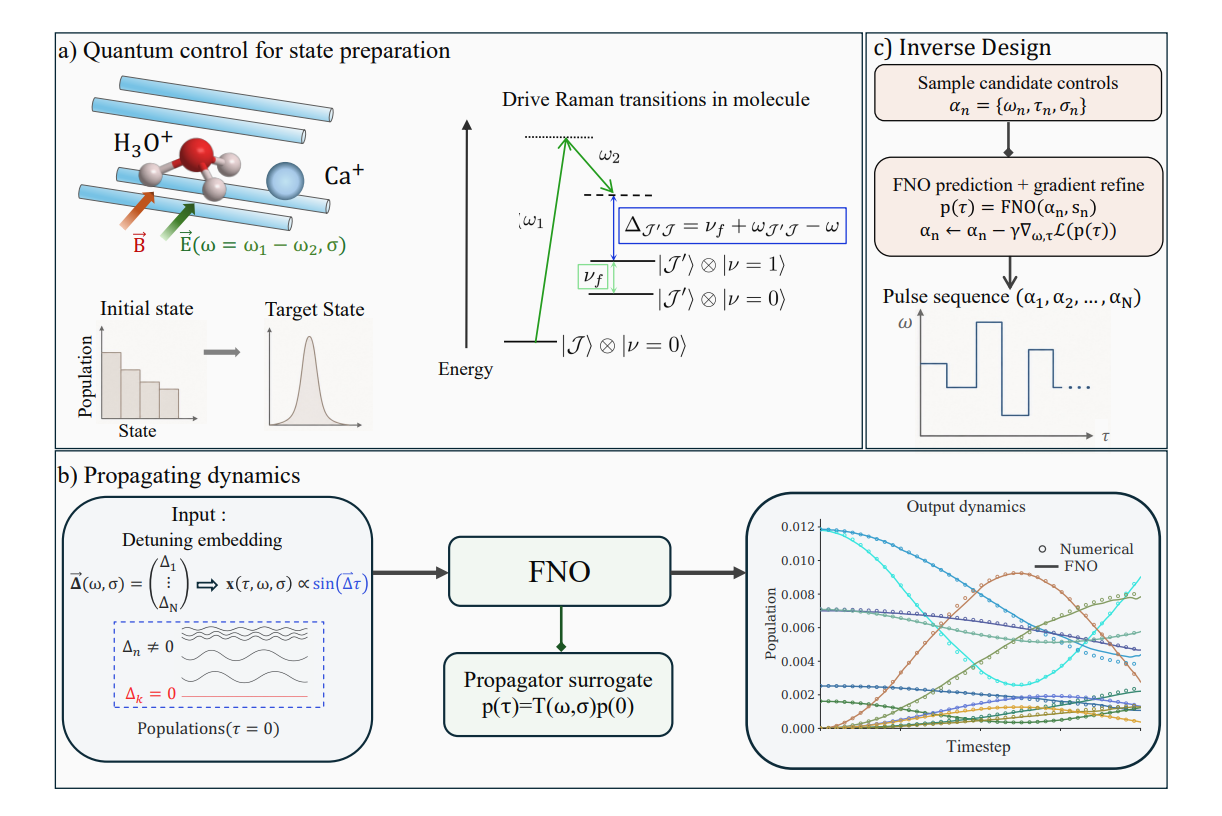
A multi-institution research collaboration led by UCLA (NarangLab), Caltech, and NVIDIA has introduced a machine-learning framework to automate the inverse design of quantum control pulse sequences. Detailed in a preprint published on arXiv (arXiv:2608.03702) and presented at IEEE Quantum Week 2026, the method utilizes a Fourier Neural Operator (FNO) to learn high-dimensional molecular quantum dynamics, replacing numerical differential equation solvers inside optimal control loops.
The FNO surrogate was trained on GPU-accelerated quantum state propagations generated by NVIDIA CUDA-Q Dynamics across an 888-dimensional Hilbert space modeling the trapped hydronium ion (H₃O⁺). Incorporating physics-informed frequency detuning embeddings and polarization symmetry constraints (σ⁺ and σ⁻ channels), the FNO surrogate predicts population trajectories across Raman sideband pulse windows up to ~10⁷× faster than accelerated GPU numerical propagation solvers. The surrogate is fully differentiable, enabling direct gradient-based optimization of continuous laser pulse parameters.
[ FNO-SPMP Control Performance vs. Reinforcement Learning Baseline ] | ||
Control Metric | Fourier Neural Operator (FNO-SPMP) | Standard Reinforcement Learning (RL) |
Target State Fidelity & Success | • Target Population Density: 0.98 • Preparation Success Rate: Up to 86.2% | • ~43% Success Rate Baseline • Higher Residual Thermal Entropy |
Sequence Overhead | • ~50% Reduction in Required Pulse Count | • 2× Larger Optical Pulse Overhead |
Synthesis Compute Latency | • 10 to 20 Minutes (Differentiable FNO) | • ~10 Hours (Discrete RL Search) |
Built on top of the differentiable FNO, the team implemented a stochastic pulse-measurement planner (FNO-SPMP) to navigate thermal population distributions at 20 K. On H₃O⁺, the framework generated pulse sequences that funneled thermal populations into single rotational/hyperfine states with an 86.2% success rate, reducing sequence synthesis latency from 10 hours down to 10–20 minutes. The methodology establishes an operator-learning paradigm within NVIDIA's CUDA-Q platform to synthesize pulse-level control for molecular spectroscopy and complex QPU gate calibration.
Review the technical update via UCLA NarangLab here, examine the peer-reviewed preprint on arXiv here, and read our prior coverage of NVIDIA CUDA-Q Platform Integrations here.
September 14, 2026
Related Intelligence

Test of USydney article with HTML.
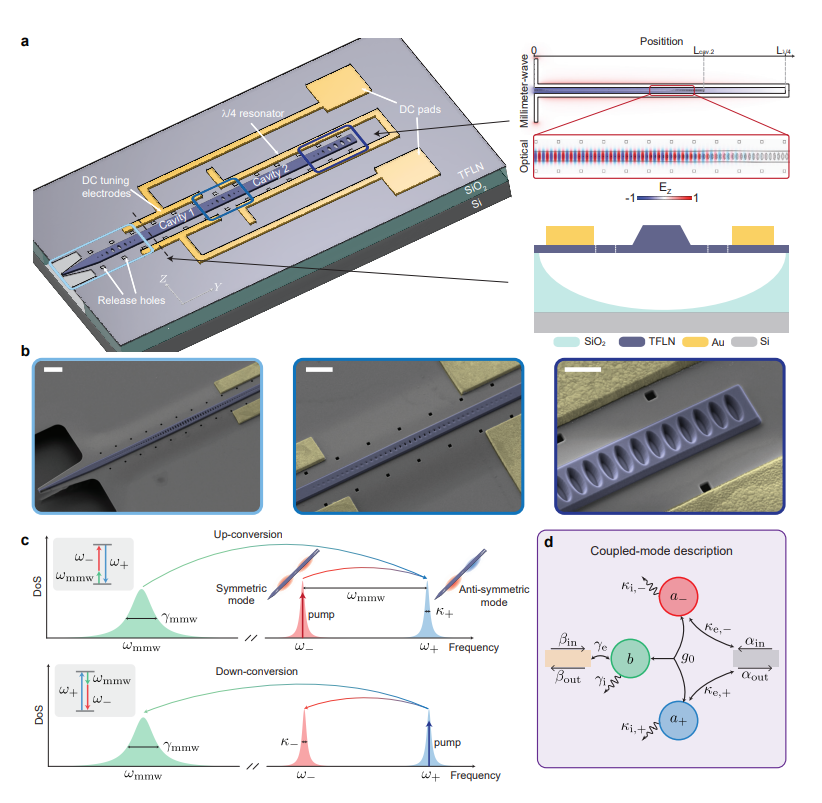
EPFL Demonstrates Millimeter-Wave-to-Optical Transducer with 67% Internal Efficiency
November 10, 2026
Why Quantum Hardware Needs Its Own Threat Model
November 9, 2026
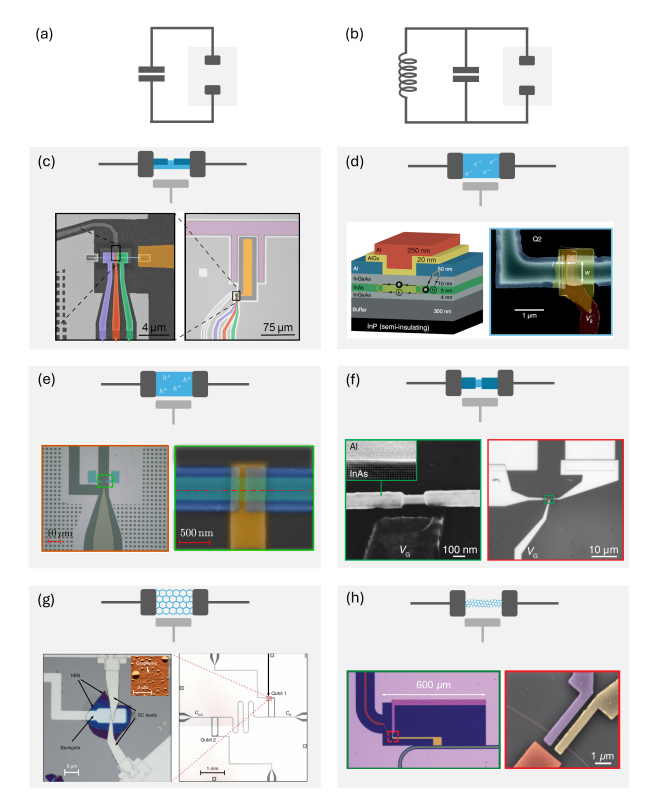
Physics Reports Analysis Evaluates Emergence of Hybrid Semiconductor–Superconducting Qubit Architectures
November 9, 2026
DLR Develops Scalable Unitary Data Encoding Beating Exponential State-Preparation Depth
November 9, 2026
IonQ and Classiq Outline Architectural Trade-Offs in Fault-Tolerant Resource Estimation
November 9, 2026