Infleqtion and UW–Madison Demonstrate 99.93% Qubit Readout Fidelity via Quadrupole Transition
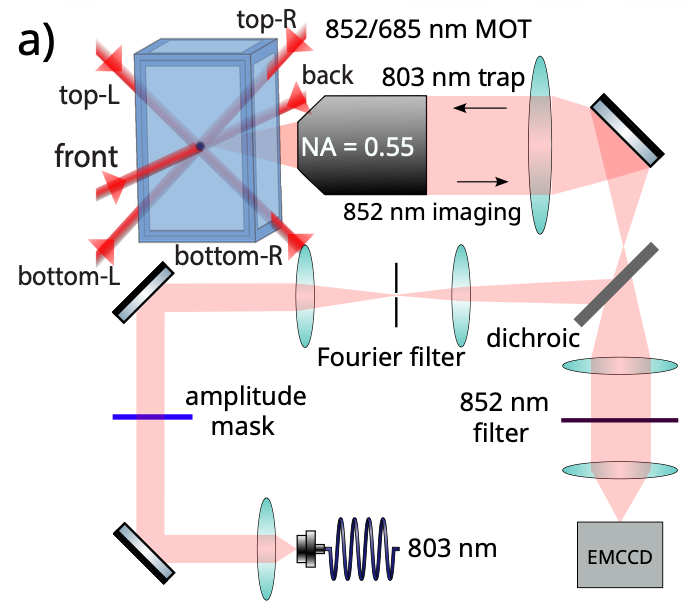
Infleqtion and the University of Wisconsin–Madison have demonstrated a nondestructive measurement technique for neutral-atom qubits, achieving a readout fidelity of 99.93% and an atom retention rate of 99.54%. The research, published in Physical Review Letters, utilizes a “forbidden” electric-quadrupole (E2) transition in cesium (Cs) atoms to perform background-free imaging while simultaneously cooling the qubit array. This approach addresses the scalability bottleneck of measurement-induced atom loss in neutral-atom architectures.
The technical architecture utilizes the 685 nm transition from the 6s1/2 ground state to the 5d5/2 excited state. Unlike traditional dipole transitions (D2 line), the 5d5/2 state possesses a significantly higher ratio of hyperfine splitting to radiative linewidth. This property enables high-fidelity, state-selective imaging with a suppressed rate of Raman depumping into the dark hyperfine ground state. Furthermore, the protocol integrates 3D laser cooling during the measurement cycle, maintaining the atoms at a temperature of 5.3 μK. This prevents heating-induced trap loss and enables repeated, low-loss measurements within the same computational circuit.
While the experimental integration time was recorded at 200 ms, the researchers provided a theoretical framework to reduce this to 60 μs. This speedup is achieved by quenching the long-lived 5d5/2 state using an auxiliary field at 3491 nm to stimulate emission to the 6p3/2 state. Numerical simulations indicate that this quenching method can increase the photon scattering rate by a factor of 50, potentially reaching a measurement fidelity of 99.95% at microsecond timescales. This temporal optimization is a prerequisite for executing the fast cycles required for quantum error correction (QEC).
This milestone supports Infleqtion’s technical roadmap as the company prepares for its public listing via a merger with Churchill Capital Corp X (NASDAQ: CCCX). By converging high-fidelity readout with continuous atom retention, the platform moves toward the "mid-circuit" measurement capabilities necessary for fault-tolerant operation. The research was supported by the National Science Foundation (NSF) and the U.S. Department of Energy (DOE) as part of the Q-NEXT center.
Read the official announcement from Infleqtion here and the full technical paper in Physical Review Letters here.
February 3, 2026
Related Intelligence

Test of USydney article with HTML.

Chips JU and Pasqal Launch €50M ($57.2M USD) Q-PLANET Pilot Line to Industrialize Neutral Atom Quantum Chips
July 13, 2026
MIT and IBM Project Quantum Unity Operators into Language Model Latent Spaces for Multimodal Circuit Synthesis
July 11, 2026

ETH Zurich Combines Superconducting Qubits with Mechanical Resonators to Build Vibrating Quantum RAM
July 11, 2026

Google and Fraunhofer Launch Global Calls for Early Fault-Tolerant Algorithms and Enterprise Use Cases
July 11, 2026

Who’s News: Strategic Appointments at Photonic, Aliro Quantum, Florida Atlantic University, QuSecure, Quantum Elements, and QAI Ventures
July 11, 2026