RIKEN and Quantinuum Demonstrate Heterogeneous Multi-QPU Workflows on Fugaku
Researchers successfully demonstrated a hybrid quantum-classical computing architecture integrating the Fugaku supercomputer with two distinct quantum…
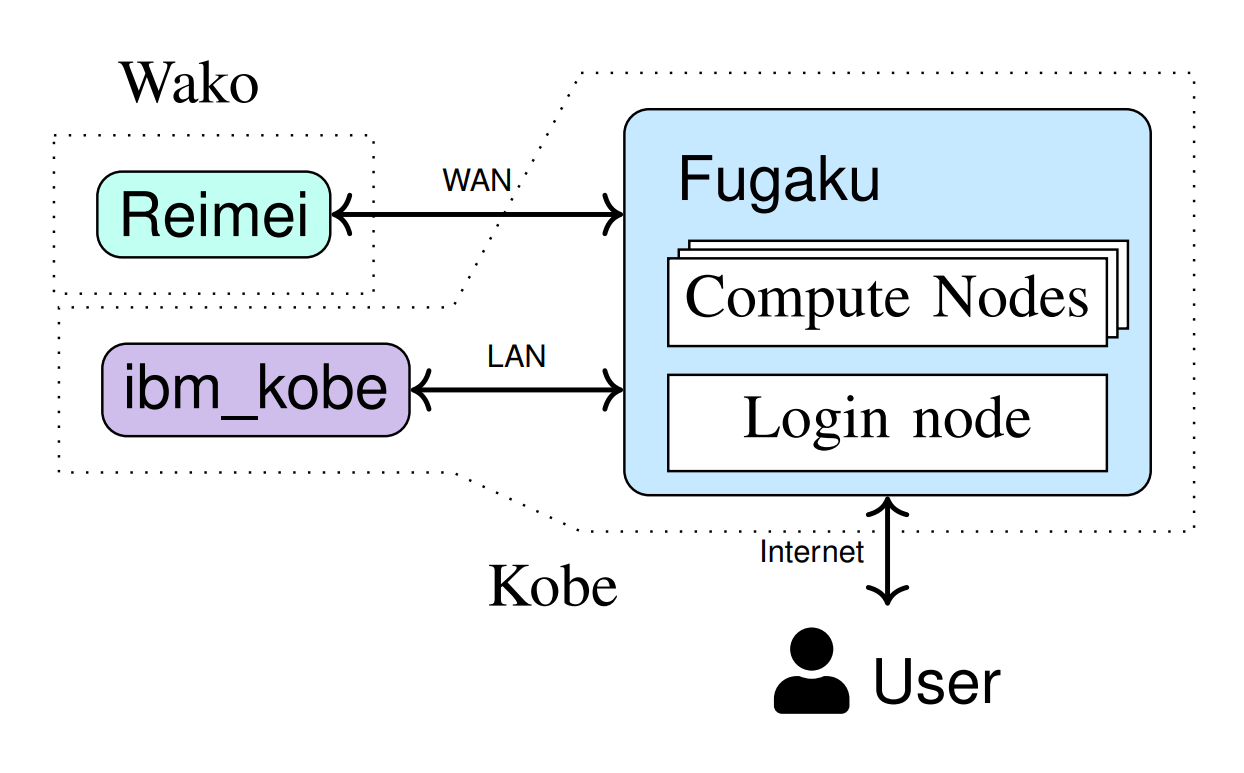
Researchers from Quantinuum, the University of Tsukuba, and the RIKEN Center for Computational Science (R-CCS) have demonstrated a hybrid computing architecture linking the supercomputer Fugaku simultaneously with two distinct physical quantum processors: the Quantinuum Reimei trapped-ion system and the ibm_kobe superconducting system. Detailed in an IEEE conference paper for SC26 titled "Quantum-HPC Workflows Across Multiple Quantum Computing Platforms: Two Case Studies," the team adapted Quantinuum's open-source Tierkreis workflow management system to native supercomputing batch environments, executing the first demonstrated multi-modality quantum-classical workflow across geographically separated QPUs.
Fugaku Multi-QPU Hybrid Architecture & Benchmark Profile | ||
Architecture Layer | Hardware & System Platform | Technical Specification & Operational Function |
Host Supercomputer | Supercomputer Fugaku (RIKEN R-CCS, Kobe) | Orchestrates distributed job execution via Fujitsu TCS (pjsub) schedulers and direct sqcsub APIs over dedicated virtual LANs. |
Superconducting Coprocessor | ibm_kobe (IBM Heron R2, 156 qubits) | Located on-site at Kobe; executes high-repetition, low-latency variational parameter optimization. |
Trapped-Ion Coprocessor | Quantinuum Reimei (H1-series, 20 qubits) | Located at Wako (~500 km away); executes deep, high-fidelity Trotterized circuits using all-to-all connectivity. |
Workflow Middleware | Tierkreis (HPC-Extended Dataflow Framework) | Directs asynchronous Directed Acyclic Graphs (DAGs), task-level state persistence, and typed executor interfaces across CPU and QPU nodes. |
Benchmark Workload | 16-site 2D Transverse-Field Ising Model (TFIM) | 4 × 4 lattice with periodic boundary conditions evaluating ground-state energy convergence. |
Hybrid Precision Scaling | VQE Warm-Start → Single-Ancilla QPE | Reduces ground-state energy error from (E − Eexact)/J = 2.47 ± 0.10 (pure VQE) down to 0.61 ± 0.36 on physical hardware. |
Hybrid quantum-classical algorithms often depend on fragmented glue code, bash scripts, and manual job handling that fail to scale within production supercomputing environments. To formalize multi-system orchestration, the authors extended Tierkreis—a dataflow framework that models computational graphs as directed acyclic structures—by introducing specialized executors for Fugaku’s native job scheduler (pjsub) and direct quantum submission channels (sqcsub). These interfaces bypass commercial cloud queues, enabling Fugaku compute and login nodes to dispatch tasks to quantum coprocessors via low-latency gRPC services.
The primary demonstration evaluated a modality-aware algorithm combining the distinct strengths of superconducting and trapped-ion hardware to compute the ground-state energy of a 16-site transverse-field Ising model. Rather than forcing a single architecture to execute the entire routine, the workflow separated the task across platforms:
Iterative State Optimization on ibm_kobe: The Variational Quantum Eigensolver (VQE) requires rapid iteration over thousands of circuit evaluations. The workflow executed 500 iterations of a parameterized Hamiltonian variational ansatz using the SPSA optimizer on the 156-qubit ibm_kobe processor, collecting 20,000 shots per circuit to find an approximate ground-state representation.
High-Fidelity Phase Estimation on Reimei: Because Quantum Phase Estimation (QPE) requires deep coherent circuits that challenge noisy systems, the parameters derived from ibm_kobe were transferred classically to seed the initial state for an Information Theory QPE algorithm on Reimei. Executed across 16 system qubits, 1 ancilla, and 3 scratch qubits dedicated to hardware leakage-detection gadgets, Reimei performed Trotterized time-evolution using 300 shots.
On physical hardware, using the fast superconducting processor to "warm-start" the trapped-ion phase estimation routine reduced the energy error to (E − Eexact)/J = 0.61 ± 0.36, substantially outperforming standalone VQE on ibm_kobe (2.47 ± 0.10) and a classically optimized product-state baseline (3.45). A secondary case study re-executed Fugaku-driven biomolecular excited-state workflows (subtractive ONIOM and TE-QSCI), validating that Tierkreis automated 80% of runtime coordination across classical chemistry packages (NTChem) and quantum circuit generation with line-level backend reconfigurability.
The work demonstrates that complex quantum chemistry and condensed-matter workflows can operate across heterogeneous quantum hardware architectures without physical quantum interconnects, using classical supercomputers as central orchestrators.
Full implementation details and algorithmic derivations are accessible in the technical preprint here and the open-source Tierkreis repository here. Related QCR coverage includes Fugaku–Reimei hybrid chemistry benchmarks here, the Reimei H2 hardware upgrade here, and the Quantinuum, RIKEN, and SoftBank quantum-AI partnership here.
November 10, 2026
Related Intelligence

Test of USydney article with HTML.

QuiX Quantum and Dutch Photonics Consortium Form National Mission for 100+ Qubit Computer
November 11, 2026
Colorado Partners with IBM to Deploy AI-Driven Quantum Ecosystem Mapping and Workforce Tools
November 11, 2026

Carahsoft Builds Federal Quantum Catalog with IonQ and PQSecure Partnerships
November 11, 2026
Diraq Installs Silicon Spin Quantum Computer in Equinix Commercial Data Center
November 11, 2026
University of Chicago and Tohoku University Establish Joint Quantum Materials Hub in Japan
November 11, 2026