Xanadu Awarded $2.0M ARPA-E Grant for Quantum Battery Research
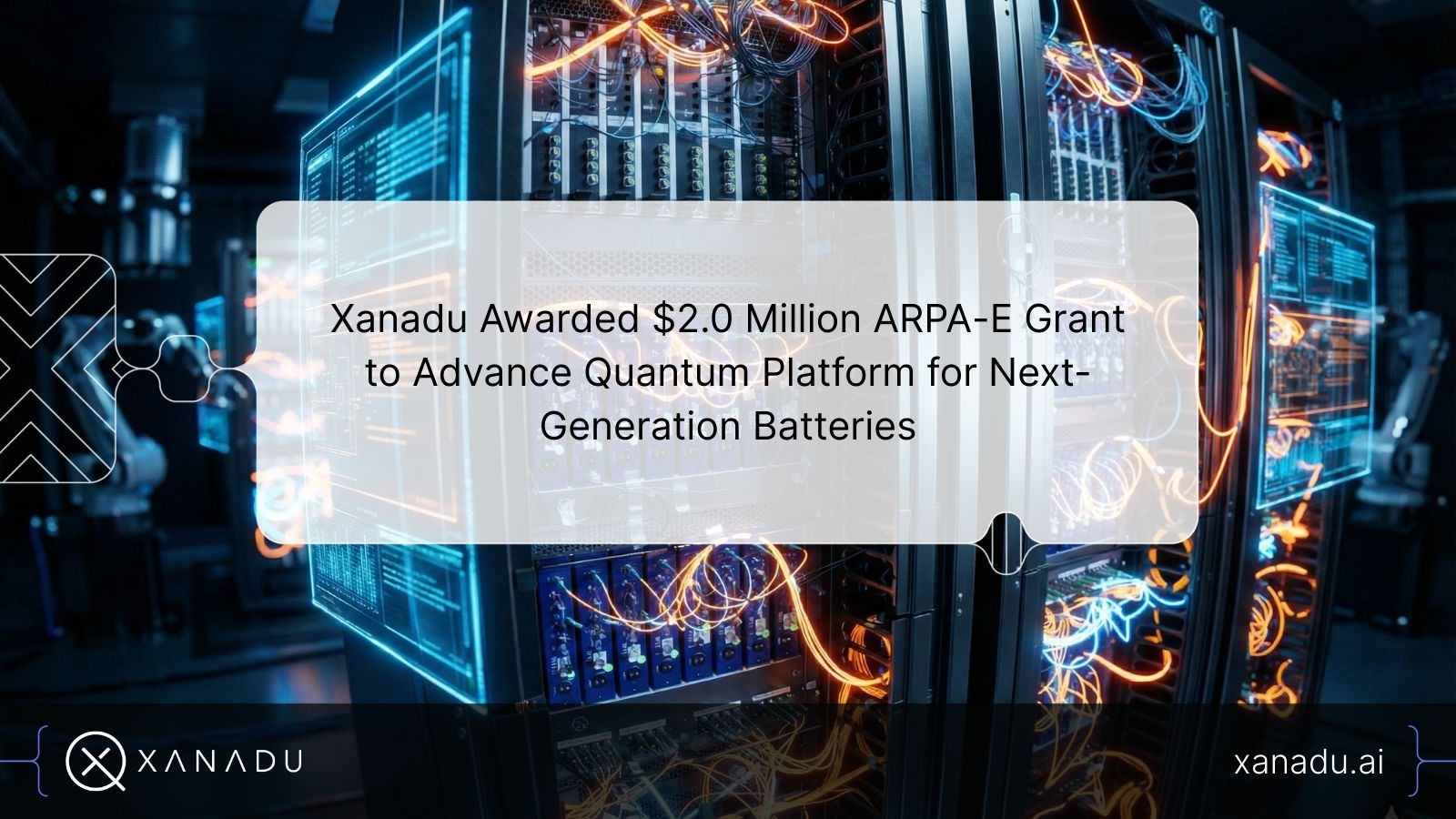
Xanadu Quantum Technologies has been awarded $2,027,507 by the U.S. Department of Energy’s Advanced Research Projects Agency-Energy (ARPA-E). The grant is part of the Quantum Computing for Computational Chemistry (QC3) program, which aims to leverage quantum algorithms for simulations in chemistry and materials science. Xanadu will lead a three-year project in partnership with the University of Chicago to develop a photonic quantum simulation platform specifically for the development of next-generation batteries.
The project focuses on modeling defect formations in battery materials to improve energy density and longevity. Technical goals include achieving a 100x reduction in runtime for these simulations compared to classical methods. To reach this benchmark, Xanadu is developing specialized algorithms for X-ray absorption spectroscopy and reaction rates, supported by molecular structures and embedding models provided by the University of Chicago. These tools are intended to be transferable to other energy sectors, including nuclear chemistry and petrochemical production.
This award coincides with Xanadu’s pending business combination with Crane Harbor Acquisition Corp. (Nasdaq: CHAC). The merger is expected to capitalize the combined entity with approximately $500 million, positioning it for listing on both the Nasdaq and the Toronto Stock Exchange. Xanadu intends to use the ARPA-E funding to establish a roadmap for fault-tolerant quantum platforms in industrial R&D, addressing computational bottlenecks currently slowing the progress of high-capacity energy storage technologies.
For further details on the project objectives and Xanadu's technical roadmap, consult the official press release here.
March 10, 2026
Related Intelligence

Test of USydney article with HTML.

Yaqumo Expands Seed Extension Round with Backing from Government-Funded JIC VGI and Toyota
July 14, 2026

NVIDIA Launches Open "Ising" Decoder Architecture to Suppress Quantum Color Code Error Rates by 347x
July 14, 2026
Nord Quantique Implements Post-Selected Stabilization to Suppress GKP Qubit SPAM Errors Below 0.1%
July 14, 2026
Tennessee Allocates $3 Million to Incentivize Local Realocation of NSF X-Labs Quantum Teams
July 14, 2026
Chips JU and Pasqal Launch €50M ($57.2M USD) Q-PLANET Pilot Line to Industrialize Neutral Atom Quantum Chips
July 13, 2026