Q-CTRL Demonstrates Push-Button Cold-Start Calibration on QuantWare Superconducting QPUs
Q-CTRL has demonstrated an autonomous, cold-start calibration process for QuantWare superconducting processors using its Boulder Opal control platform. …
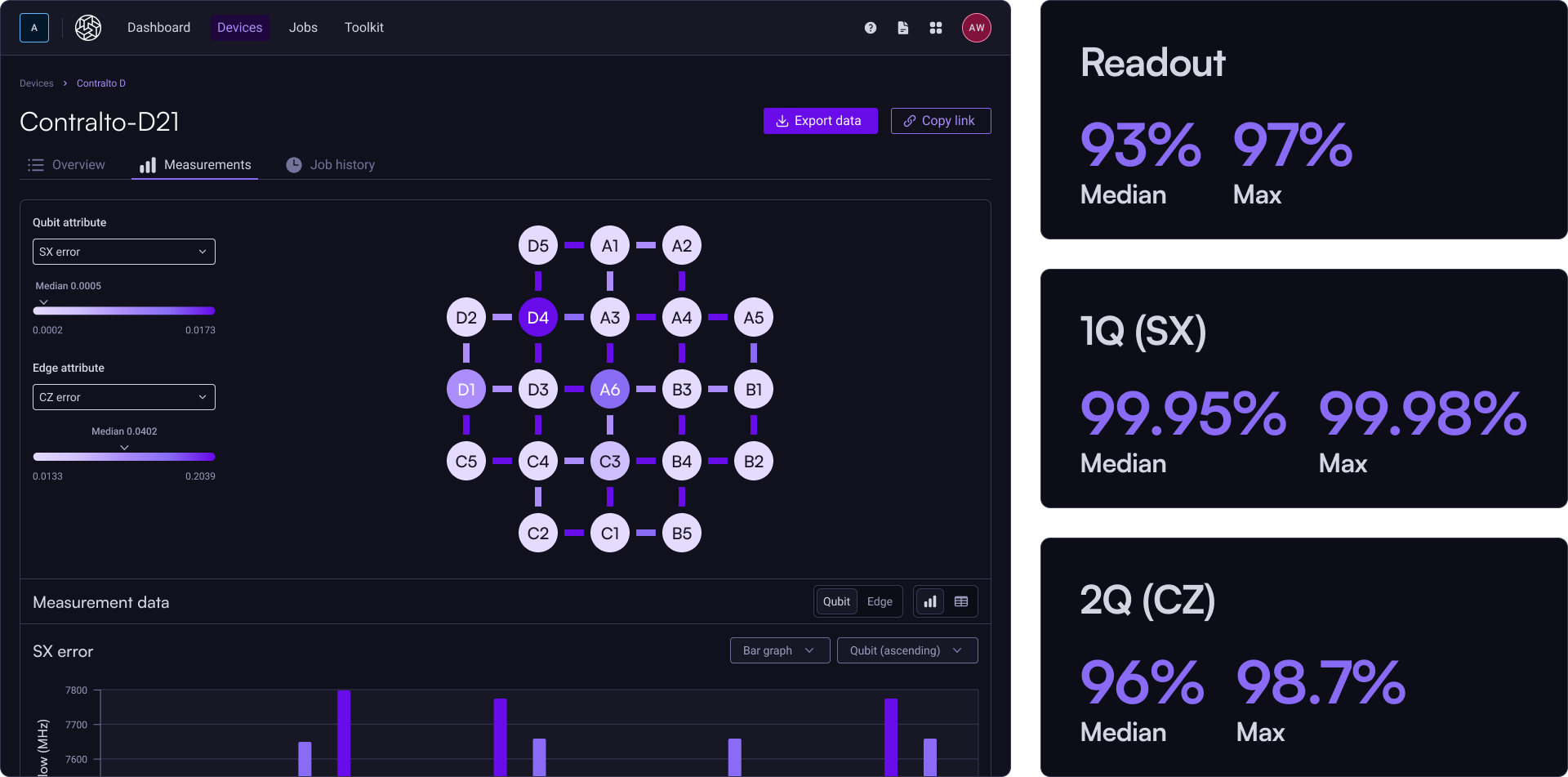
Quantum infrastructure software provider Q-CTRL has released hardware benchmarking data demonstrating fully autonomous, cold-start bring-up and gate calibration on QuantWare D-Line superconducting processors using its Boulder Opal control platform. Validated on a 21-qubit QuantWare Contralto-D21 device, the physics-informed AI state machine tuned five-qubit feedline blocks from an uncalibrated state to operational gate fidelities in under three hours without manual specialist intervention.
Boulder Opal Autonomous Bring-Up Benchmarks (QuantWare Contralto-D21) | ||
Calibration Dimension | Measured Benchmark | Operational & Hardware Role |
Cold-Start Bring-Up Time | <3 hours per 5-qubit feedline | Replaces multi-day manual tuning cycles across resonator mapping and qubit discovery. |
Single-Qubit Gate Fidelity | 99.95% median (SX gates) | Automated Rabi, Ramsey, and readout optimization across stable transmon registers. |
Two-Qubit Gate Fidelity | >98% peak / 96% device median (CZ gates) | Flux spectroscopy and closed-loop pulse optimization across coupled qubit pairs. |
Upcoming Roadmap | QuantWare A-Line & runtime recalibration | Adds tunable-coupler support, task parallelization, and continuous drift tracking in late 2026. |
Scaling superconducting quantum computers presents a severe operational bottleneck because dozens of interdependent control parameters—ranging from traveling-wave parametric amplifier (TWPA) biases to qubit drive frequencies and flux pulses—must be iteratively tuned and stabilized against environmental drift. Conventional scripted calibration routines frequently fail when hardware frequencies drift outside narrow scan windows, requiring experimental physicists to intervene manually.
Boulder Opal encodes architecture-specific characterization and calibration routines into an automated state machine capable of detecting out-of-range anomalies, filtering false-positive resonances, and recovering underperforming qubits autonomously. Every calibration pass logs parameter histories, diagnostic plots, and optimized control waveforms into a web-based visualization dashboard for hardware inspection.
Technical details and calibration metrics are available on the Q-CTRL blog here. Related QCR coverage of Q-CTRL’s autonomous calibration integration with Anyon Technologies for enterprise data centers is available here.
November 11, 2026
Related Intelligence

Test of USydney article with HTML.
IBM Unveils 520-Qubit Nighthawk r3 Processor, 1,040-Qubit Linked Roadmap, and Managed Hybrid Workflows at QDC 2026
November 12, 2026
Q-CTRL Deploys Fire Opal Dynamics Simulator on IBM Quantum Functions, Achieving 12× Speedup on Nighthawk
November 12, 2026
Q-CTRL Expands Fire Opal Suite with Constrained Optimization, Estimator Twirling, and Monte Carlo Solver
November 12, 2026

Q-CTRL Achieves RTCA DO-160 Airworthiness Qualification for Ironstone Opal Quantum Navigation
November 12, 2026
Anyon Technologies and Q-CTRL Partner on Self-Calibrating Hybrid Quantum Supercomputers
November 12, 2026