Q-CTRL Deploys Fire Opal Dynamics Simulator on IBM Quantum Functions, Achieving 12× Speedup on Nighthawk
Q-CTRL has deployed its Fire Opal Dynamics Simulator on IBM Quantum Functions, achieving a 12x speedup on Nighthawk r2 processors compared to Heron r3…
Quantum infrastructure software provider Q-CTRL has released its Dynamics Simulator function inside the IBM Quantum Functions Catalog, enabling researchers to execute large-scale fermionic many-body physics simulations on IBM superconducting processors via a single automated API call. Following its initial rollout in Fire Opal and recent benchmarks on IBM’s Nighthawk r2 (ibm_phoenix) architecture, the pipeline demonstrated a 12× execution speedup over IBM Heron r3 systems with less than 1% fidelity deviation.
Q-CTRL Fire Opal Dynamics Simulator Hardware Benchmarks | ||
Benchmark Metric | IBM Heron r3 (ibm_boston) | IBM Nighthawk r2 (ibm_phoenix) |
Workload Scale | Up to 60 sites (120 qubits, 30 Trotter steps, 9,057 2Q gates) & 31 sites (62 qubits, 90 Trotter steps, 13,829 2Q gates) | 30-site Fermi-Hubbard chain (60 qubits, 30 Trotter steps, 4,497 2Q gates, 2Q depth 152) |
QPU Pipeline Runtime | 4 minutes 25 seconds (30-site reference, including noise characterization) | 23 seconds (12× faster QPU execution) |
Classical Comparison | Up to 3,000× faster than ITensor CPU baseline (36× vs. symmetry-exploiting H200 GPU tensor networks) | >400× faster lower-bound runtime vs. GPU-accelerated classical solvers |
Simulation Accuracy | Within ~1% RMSE of converged tensor-network references | <1% deviation (7.895 × 10⁻³ RMSE) vs. Heron r3 baseline |
Computational chemistry and materials modeling consume roughly one-third of global supercomputer capacity, yet simulating time-evolving, strongly correlated electrons remains constrained by exponential entanglement growth in classical tensor networks. While IBM’s Nighthawk square-lattice topology increases average qubit connectivity by 60% over heavy-hex Heron chips—reducing SWAP routing overhead—denser nearest-neighbor coupling amplifies residual quantum crosstalk. Earlier validation on Nighthawk r1 (ibm_miami) showed that staggered dynamical decoupling extends median effective coherence times sixfold, from 27 μs to 160 μs.
The Dynamics Simulator abstracts Hamiltonian mapping, Trotter-Suzuki synthesis, qubit routing, and deterministic crosstalk suppression behind a high-level Python interface (q-ctrl/dynamics-simulator). By preventing coherent errors during execution without extra measurement shots, Q-CTRL previously simulated 1D Fermi-Hubbard dynamics up to 120 qubits on IBM Heron hardware across 90 Trotter steps. While follow-up classical research utilizing symmetry-exploiting tensor contractions on NVIDIA H200 GPUs narrowed Q-CTRL’s initial 3,000× CPU speedup to 36×, transitioning the workflow to Nighthawk r2 restored an order-of-magnitude runtime margin.
Available in Small, Medium, and Large workload tiers for IBM Quantum Premium, Flex, and On-Prem Plan users, the Dynamics Simulator completes Q-CTRL’s three-function lineup in the IBM Quantum Functions Catalog alongside its Performance Management and Optimization Solver functions.
Official release details are available in Q-CTRL’s IBM Quantum Functions announcement here, the Nighthawk r2 benchmark analysis here, the Nighthawk r1 crosstalk suppression study here, and the initial Fire Opal Dynamics Simulator release here. Catalog listings and documentation are accessible for the Dynamics Simulator here (docs here), Performance Management here (docs here), and the Optimization Solver here (docs here). Supporting scientific manuscripts include Q-CTRL’s Fermi-Hubbard hardware study on arXiv here, the GPU tensor-network benchmarking response on arXiv here, and the supercomputer chemistry workload study in Machine Learning: Science and Technology here. Related QCR coverage of Q-CTRL’s initial materials simulation speedup is available here, recent Fire Opal solver and compiler updates here, and IBM’s QDC 2026 Nighthawk roadmap here.
November 11, 2026
Related Intelligence

Test of USydney article with HTML.
IBM Unveils 520-Qubit Nighthawk r3 Processor, 1,040-Qubit Linked Roadmap, and Managed Hybrid Workflows at QDC 2026
November 12, 2026
Q-CTRL Expands Fire Opal Suite with Constrained Optimization, Estimator Twirling, and Monte Carlo Solver
November 12, 2026
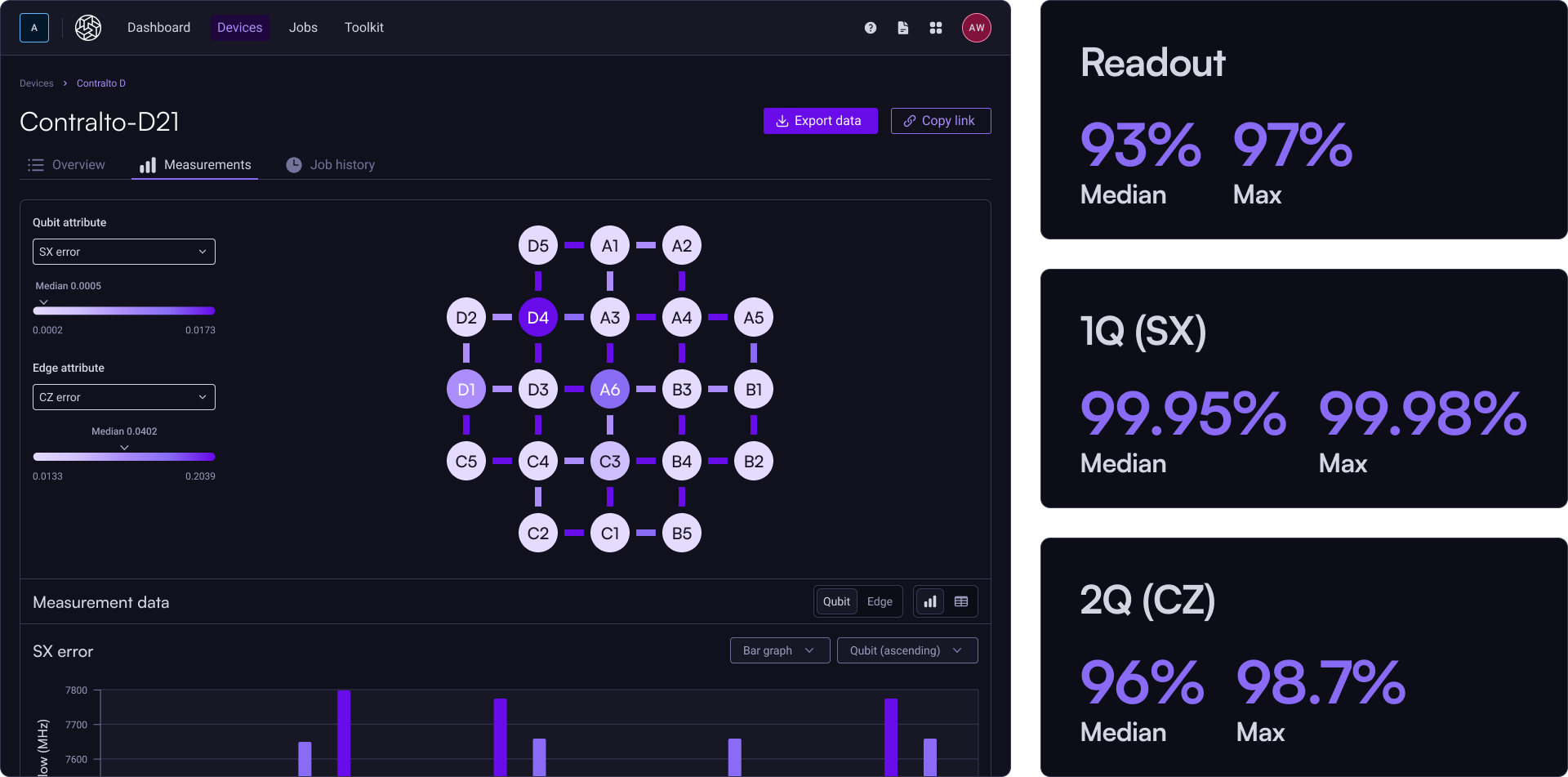
Q-CTRL Demonstrates Push-Button Cold-Start Calibration on QuantWare Superconducting QPUs
November 12, 2026

Q-CTRL Achieves RTCA DO-160 Airworthiness Qualification for Ironstone Opal Quantum Navigation
November 12, 2026
Anyon Technologies and Q-CTRL Partner on Self-Calibrating Hybrid Quantum Supercomputers
November 12, 2026