IBM, Mitsubishi Chemical, and Keio Train Generative Quantum Eigensolvers on 70-Qubit Hardware
IBM Quantum, Mitsubishi Chemical, Keio University, and NVIDIA have successfully demonstrated a quantum hardware training framework for generative quantum…
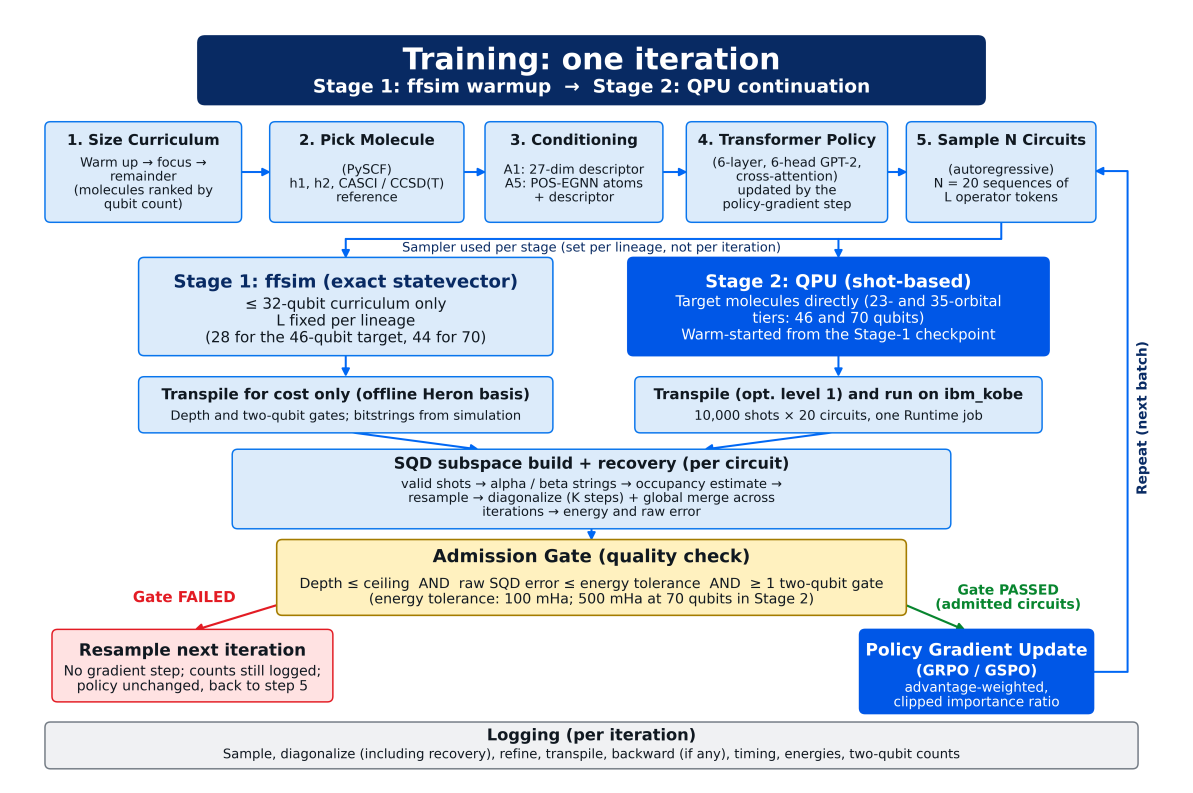
A research consortium comprising IBM Quantum, Mitsubishi Chemical Corporation, Keio University, and NVIDIA has demonstrated an in-the-loop quantum hardware training framework for autoregressive circuit generators up to 70 qubits. Published on arXiv, the study used the 156-qubit IBM Heron processor ibm_kobe to train transformer-based Generative Quantum Eigensolver (GQE) policies, which were subsequently applied zero-shot to simulate complex organotin photoresist molecules for extreme ultraviolet (EUV) lithography.
70-Qubit GQE-SQD vs. Conventional LUCJ Ansatz Performance | ||
Architecture Dimension | Hardware-Trained GQE Policy | Transpiled LUCJ Baseline |
State Preparation Model | Autoregressive transformer conditioned on molecular descriptors | Fixed spin-balanced Local Unitary Cluster Jastrow operator |
2-Qubit Gate Count (56–70 Qubits) | 64 to 160 gates | 4,248 to 6,952 gates |
Transpiled Circuit Depth | 44 to 134 layers | 428 to 536 layers |
Active Space Target | Organotin hydroxides and hydrates (32 to 70 qubits) | Identical chemical active-space benchmarks |
DMRG Agreement (46–70 Qubits) | 27 of 28 runs within 15 mHa (median 4.5 mHa deviation) | 22.7 to 204.1 mHa raw deviation before excitation injection |
Simulating strongly correlated electrons in organometallic clusters presents an exponential barrier for classical configuration interaction methods, while deep parameterized circuits quickly decohere on physical quantum processors. Under Sample-based Quantum Diagonalization (SQD), the quantum processor only samples salient bitstring configurations, after which a classical processor reconstructs the active subspace and diagonalizes the molecular Hamiltonian. State preparation quality dictates recovery accuracy, but conventional ansätze often generate prohibitive gate depths once mapped to physical hardware topologies.
To eliminate manual circuit synthesis, the team implemented a two-stage reinforcement learning curriculum. After initial pre-training on a noiseless simulator across transition-metal complexes, training continued directly on the ibm_kobe processor across 46- and 70-qubit active spaces. The Stage-2 training loop incorporated a specialized reward penalty to prevent policy collapse onto the classical Hartree–Fock state, consuming 120 million physical hardware shots across 600 calibration jobs.
The resulting policies were deployed without retraining against 11 active-space tiers of methyltin trihydroxide, Sn(OH)3-Me, and its mono- and di-hydrates. In operational inference, the policy proposes ten candidate circuits that are executed in a single quantum batch job. A classical ranking pass evaluates configuration counts to select the optimal circuit, after which subspace recovery and Hamiltonian diagonalization proceed entirely on local GPUs without requiring additional quantum execution time.
The research was supported in part by Japan’s Cross-ministerial Strategic Innovation Promotion Program (SIP) and the RIKEN JHPC-quantum initiative. Full technical details are available in the preprint on arXiv here, open-source code on GitHub here, and experimental datasets on Zenodo here.
November 11, 2026
Related Intelligence

Test of USydney article with HTML.
IBM Unveils 520-Qubit Nighthawk r3 Processor, 1,040-Qubit Linked Roadmap, and Managed Hybrid Workflows at QDC 2026
November 12, 2026
Q-CTRL Deploys Fire Opal Dynamics Simulator on IBM Quantum Functions, Achieving 12× Speedup on Nighthawk
November 12, 2026
Q-CTRL Expands Fire Opal Suite with Constrained Optimization, Estimator Twirling, and Monte Carlo Solver
November 12, 2026
Q-CTRL Demonstrates Push-Button Cold-Start Calibration on QuantWare Superconducting QPUs
November 12, 2026

Q-CTRL Achieves RTCA DO-160 Airworthiness Qualification for Ironstone Opal Quantum Navigation
November 12, 2026